PDF Page 1
A Preference Signals Framework to Protect the Commons

PDF Page 2
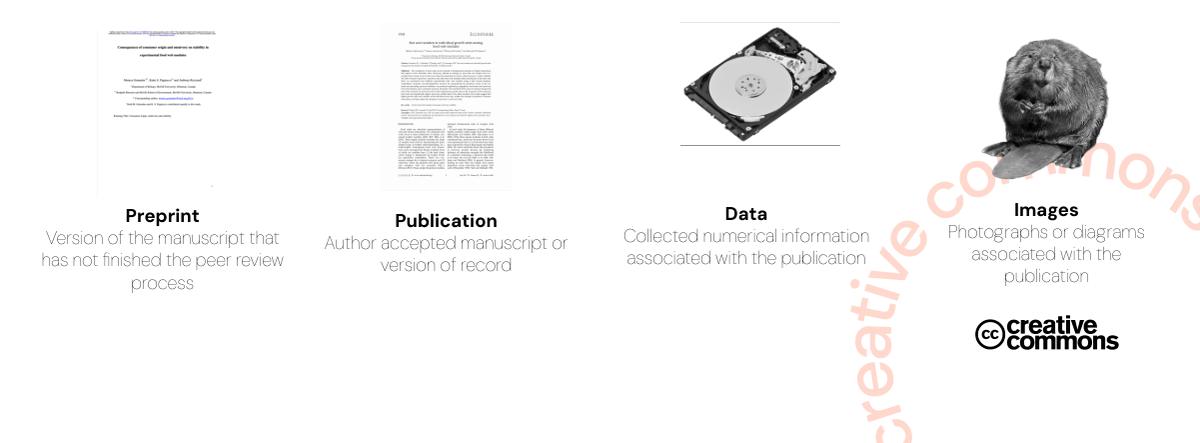
Preprint Version of the manuscript that has not finished the peer review
process
Publication Author accepted manuscript or
version of record
Images Photographs or diagrams
associated with the
publication
Data Collected numerical information
associated with the publication
The Commons includes open science
PDF Page 3
AI models have crawled significant portions of the public web to collect training data including mass quantities of CC licensed work. These models do not attribute credit or use citations, core tenets of the scientific process.
AI models
PDF Page 4
We believe that the current practices of AI companies pose a threat to the commons which includes open science. Many researchers are feeling betrayed by how AI is being developed and deployed. We fear that researchers will no longer want to share publicly at all and that isn’t good for humans. CC signals is an initial attempt at finding a solution to this very challenging problem.
Why CC signals?
PDF Page 5
The Development of CC Signals is Based on:
●Our belief that there are many legitimate purposes for machine reuse of content that must be protected
●An ecosystem that better addresses the valid concerns of those creating and stewarding human knowledge is both possible and necessary

PDF Page 6
As human content becomes data for machines, we want to build a new social contract that will govern that relationship.
Our Goal
PDF Page 7
CC Signals: At A Glance
●A steward of a collection of content, such as a repository of research outputs, applies a signal to express a set of criteria about how the content can be used by machines.
PDF Page 8
CC BY-NC-ND 2.0.
Credit: You must give appropriate credit based on the method, means, and context of your use.
Direct Contribution: You must provide monetary or in-kind support to the Declaring Party for their development and maintenance of the assets, based on a good faith valuation taking into account your use of the assets and your financial means.
Ecosystem Contribution: You must provide monetary or in-kind support back to the ecosystem from which you are benefiting, based on a good faith valuation taking into account your use of the assets and your financial means.
Open: The AI system used must be open. For example, AI systems must satisfy the Model Openness Framework (MOF) Class II, MOF Class I, or the Open Source AI Definition (OSAID).
PDF Page 9
Thank you!
PDF Page 10
There are many scenarios where compliance with CC license conditions is not required when using CC-licensed works for AI training.
For more:
Using CC-licensed Works for AI Training