PDF Page 1
1
AI Neutrality
Jan. 2026

PDF Page 2
The Vanderbilt Policy Accelerator focuses on cutting-
edge topics in political economy and regulation to swiftly
bring research, education, and policy proposals from
infancy to maturity.
ABOUT THE VANDERBILT POLICY ACCELERATOR
Asad Ramzanali is the Director of AI and Technology
Policy at the Vanderbilt Policy Accelerator for Political
Economy and Regulation.
Akhil Rajan is pursuing a JD/PhD at Yale University.
Acknowledgements: The authors thank Adam Conner,
Hannah Garden-Monheit, Daniel Hanley, Tejas
Narechania, Ganesh Sitaraman, Joel Thayer, Max von
Thun, Vivek Viswanathan, and Tim Wu for helpful
comments and conversations.
ABOUT THE AUTHORS

PDF Page 3
Table of Contents
Introduction ................................................................................................................. 4
I. Background............................................................................................................... 6
II. Case Study: Anthropic Cut Access to Windsurf ............................................ 13
III. Neutrality Can Support Innovation ................................................................ 17
Conclusion ................................................................................................................ 20
Appendix: Sample Legislative Language ............................................................ 21
PDF Page 4
Introduction Generative AI has become hard to avoid. Nearly all Americans have now queried an AI chatbot like Claude or ChatGPT, read AI Overviews atop Google Search, watched AIgenerated videos on social media created by Vibes or Sora, or used Microsoft Copilot at work. Each of these products is actually two things: an application (e.g., chatbot) and the underlying AI foundation model (FM) that powers it. While many of the most popular consumer-facing AI applications are vertically integrated model-application pairs (e.g., OpenAI’s ChatGPT uses OpenAI’s GPT models), those same companies make AI FMs available to third parties as a service, making AI FMs a platform for AI applications. Like prior platforms, AI FM providers have inherent conflicts of interest that public policy should aim to limit. This report recommends imposing a neutrality requirement when FMs serve these third parties, similar to net neutrality rules originally proposed by Tim Wu in 2003 for broadband providers.1 Today, AI is an economic and geopolitical priority. But maintaining national leadership requires contestable and innovative markets. Monopolistic gatekeepers should not be able to pick winners and losers. As AI applications increase in use, AI FMs retain market power over a significant number of startups, large businesses, and governments that are developing applications. Policymakers can thwart incentives for AI FMs to adopt the same unfair and anticompetitive tendencies in other markets by requiring neutrality. Companies develop increased market power as their technology becomes essential to commerce. If FM providers are able to discriminate between their customers (i.e., third-party AI application developers that rely on FMs), that power allows them to skew or hinder innovation when it is at odds with their own financial incentives. As an example, we explore the case of Windsurf, a startup that produced a leading AI agent that generates or reviews software code upon user request (commonly called “vibe coding,” one dictionary’s word of the year for 20252). By default, Windsurf users accessed an FM developed by Anthropic that Windsurf had fine-tuned. When reports surfaced that OpenAI might acquire Windsurf, Anthropic cut off Windsurf’s access. Anthropic executives explicitly stated that the move was aimed at avoiding helping OpenAI, their chief competitor. But Anthropic had an additional incentive to
1 Tim Wu, Network Neutrality, Broadband Discrimination, 2 J. ON TELECOMM. & HIGH TECH. L. 141 (2003).
2 Lakshmi Varanasi, Vibe-Coding Is Now an Official Word in the Dictionary, BUS. INSIDER (Nov. 9, 2025), https://www.businessinsider.com/vibe-coding-dictionary-2025-11.
PDF Page 5
deprioritize developers offering AI coding agents because it has its own vertically integrated model-application AI coding agent, Claude Code. More recently, Anthropic was again in the news when it curtailed FM access to xAI’s use of Cursor (Anthropic blocked a specific customer of its customer).3 These examples surfaces broader issues in the FM market regarding conflicts of interest, anticompetitive behavior, and fairness as FM providers have become gatekeepers.4 In effect, a dominant FM provider can exercise a kill switch (or even a less detectable nob that enables throttling of services) against its customers when they become competitors—an existential risk for startups. This sort of anti-competitive power, where economic dominance in a primary market bleeds into a secondary market, has occurred in other concentrated sectors, such as telecommunications,5 banking,6 search,7 and e-commerce.8 Given the FM market’s tendency toward concentration9 and FM providers’ degree of vertical integration,10 abuse of power may also occur in less visible ways outside of market transactions. This blueprint recommends a mandate that AI FMs providers adhere to neutrality rules among their customers and potential customers. The core principle of neutrality is that FM developers should not be able to unreasonably or unjustly discriminate among pricing, speed, or service quality among similarly situated users, including the FM provider’s own uses or in which they have material interests. In doing so, we aim to maintain fairness, contestability, and innovation that should power the AI economy.
3 Carl Franzen, Anthropic Cracks down on Unauthorized Claude Usage by Third-Party Harnesses and Rivals, VENTUREBEAT (Jan. 9, 2026), https://venturebeat.com/technology/anthropic-cracks-down-onunauthorized-claude-usage-by-third-party-harnesses.
4 For a fuller discussion of this case study, see infra Part II.
5 See, e.g., Timothy Karr, Net Neutrality Violations: A History of Abuse, FREE PRESS (July 9, 2021), https://www.freepress.net/blog/net-neutrality-violations-history-abuse.
6 See, e.g., Evan Weinberger, Wells Fargo, PNC Push Fintechs to Use Bank-Backed Data Firm, BLOOMBERG LAW (Nov. 4, 2025), https://news.bloomberglaw.com/banking-law/wells-fargo-pnc-pushing-fintechs-to-usebank-backed-data-firm.
7 Case T-612/17, Google & Alphabet v. Comm’n, ECLI:EU:T:2021:763, ¶ 286 (Gen. Ct. Nov. 10, 2021) (Google “treat[ed] results from competing comparison shopping services less favourably than those from its own.”).
8 Eur. Comm’n, Commission Decision in Case AT.40462 (Amazon Marketplace) & Case AT.40703 (Amazon Buy Box), ¶ 7 (Dec. 20, 2022) (Finding that Amazon gave its own retail unfair visibility over third party sellers).
9 Jai Vipra & Anton Korinek, Market Concentration Implications of Foundation Models: The Invisible Hand of ChatGPT, BROOKINGS INST. (Sept. 7, 2023), https://www.brookings.edu/articles/market-concentrationimplications-of-foundation-models-the-invisible-hand-of-chatgpt/.
10 See infra Part I.
PDF Page 6
I. Background
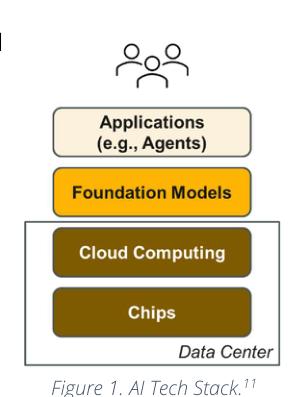
The AI market is commonly conceptualized as a technological “stack” with four main layers—chips, cloud computing, FMs, and applications—as depicted in Figure 1.11 For a simplified example of how the layers of the stack interact, consider OpenAI’s ChatGPT: Consumers interact with ChatGPT, a chatbot application powered by underlying AI FMs (e.g., GPT5.2, GPT-4.1) that were largely trained using Nvidia chips in Microsoft cloud computing data centers. Generally, each layer is dependent on lower layers. Innovation in applications, then, depends on a healthy FM market, which is the focus of this proposal, though some insights and examples apply to other layers as well. While consumers in our simplified example interact with the combined OpenAI offering that includes an application (i.e., ChatGPT) and AI FMs, OpenAI also provides direct access to its FMs as a service to external application developers via an application programming interface (API). Some applications allow users to toggle between thirdparty FMs and the application developer’s fine-tuned model, while others only operate on top of a single model. FMs are a type of large AI model trained on broad types of data, fine-tuned by developers, and then deployed to predict or generate content (inference, in industry parlance). A pre-trained AI FM consists of an algorithm with
11 Figure adapted from Written Testimony of Asad Ramzanali, in AI in the Everyday: Current Applications and Future Frontiers in Communications and Technology, H. Hrg. 119-23 before the Comm. on Energy & Com., 119th Cong., 63 (June 4, 2025), https://www.govinfo.gov/content/pkg/CHRG119hhrg60730/pdf/CHRG-119hhrg60730.pdf. Similar AI tech stacks are described by, e.g., Andrew W. Moore, Martial Hebert & Shane Shaneman, The AI Stack: A Blueprint for Developing and Deploying Artificial Intelligence, in Proc. SPIE Vol. 10635, GROUND/AIR MULTISENSOR INTEROPERABILITY, INTEGRATION, AND NETWORKING FOR PERSISTENT ISR IX, 106350C–2 (2018); NAT'L SEC. COMM'N ON A.I., Final Report 31 (2021), https://reports.nscai.gov/final-report/; THE WHITE HOUSE, America’s AI Action Plan 20 (July 2025), https://www.whitehouse.gov/wp-content/uploads/2025/07/Americas-AI-Action-Plan.pdf.
12 Rishi Bommasani et al., On the Opportunities and Risks of Foundation Models, STAN. INST. FOR HUMANCENTERED AI, 3 (2021), http://arxiv.org/abs/2108.07258.
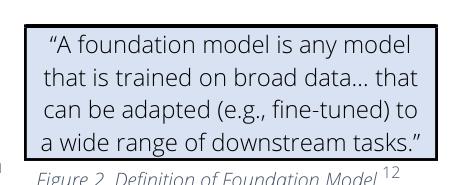
“A foundation model is any model that is trained on broad data… that can be adapted (e.g., fine-tuned) to a wide range of downstream tasks.”
Figure 2. Definition of Foundation Model.12
Figure 1. AI Tech Stack.11
PDF Page 7
learned numerical parameters (i.e., weights) that encode patterns based on training data and determine how the model generates outputs. Today, the market for FMs can be broadly categorized into closed- and open-weight FMs. Closed-weight FMs keep their model weights private and accessible only to the developer, while open-weight FMs publish details needed to customize or use their models independently. While closed-weight models once enjoyed a significant capability advantage, some evidence suggests the gap has narrowed.13 The AI FMs most commonly used for commercial applications are developed by the largest American technology companies. Popular closed-weight include OpenAI’s GPT-4 and GPT-5 FMs, Anthropic’s Claude FMs, Google’s Gemini FMs, Amazon’s Nova FMs, and xAI’s Grok FM. Popular open-weight models include Meta’s Llama FMs, Deepseek’s V3 and R1, Alibaba Qwen, Mistral FMs, and OpenAI GPT-OSS. Generally, an AI application developer wishing to use a closed-weight model will pay the FM company for access, through a digital middleman known as an API. Closedweight models require a formal customer-supplier relationship, while open-weight FMs typically allow users to freely modify, fine-tune, or locally deploy an FM. Open-weight FMs can have pro-competitive effects on the AI FM market by offering consumers free alternatives to major players.14 In theory, an open-weight FM shouldn’t have the technical capacity to discriminate among customers, though actual openness has limits and exists on a gradient.15 In practice, however, many of the most popular open-weight FMs like Meta’s Llama family of FMs require power users to sign licensing agreements. In theory, these companies could use licensing terms to discriminate among its customers. While the remainder of this paper focuses on closed-weight models that
13 Nestor Maslej et al., Artificial Intelligence Index Report 2025, STAN. INST. FOR HUMAN-CENTERED AI 13 (Apr. 2025), https://hai.stanford.edu/assets/files/hai_ai_index_report_2025.pdf.
14 Jack Corrigan, Promoting AI Innovation Through Competition, CTR. FOR SEC. & EMERGING TECH. 23–24 (May 2025), https://cset.georgetown.edu/publication/promoting-ai-innovation-through-competition/; OECD, AI Openness: A Primer for Policymakers, OECD A.I. PAPERS (Aug. 14, 2025), https://www.oecd.org/en/publications/ai-openness_02f73362-en.html.
15 Irene Solaiman, The Gradient of Generative AI Release: Methods and Considerations, in FAccT '23: PROCEEDINGS OF THE 2023 ACM CONFERENCE ON FAIRNESS, ACCOUNTABILITY, AND TRANSPARENCY 111 (2023), https://dl.acm.org/doi/10.1145/3593013.3593981; David Gray Widder, Meredith Whittaker & Sarah Myers West, Why ‘Open’ AI Systems Are Actually Closed, and Why This Matters, 635 NATURE 827 (2024); AI Openness: A Primer for Policymakers, OECD A.I. PAPERS (Aug. 14, 2025), https://www.oecd.org/en/publications/ai-openness_02f73362-en.html.
PDF Page 8
have more avenues for discriminating among their customers, the ideas apply to AI FMs that are described as open-weight but retain the ability to discriminate. The total market size of FMs (i.e., enterprises spending to access FM APIs) was $37 billion in 2025,16 which is relatively small compared to adjacent AI tech stack markets (e.g., $944 billion for cloud computing17 and $772 billion for semiconductor chips18) though the market is relatively new and growing.19 Even after including subscription fees from direct-to-consumer applications, AI FM developers like OpenAI and Anthropic posted billions in net losses last year.20 Despite the relatively small size of the direct market, AI FMs have become critical suppliers to the larger technology industry. Approximately half of Y Combinator’s Winter 2024 and Spring 2025 batches of startups are building AI applications,21 with most being built atop FMs. Thus, while much attention has focused on other layers of the stack that dominate current spending, market power at the FM layer poses significant risk to application innovation going forward.
16 Tim Tully et al., 2025: The State of Generative AI in the Enterprise, MENLO VENTURES (Dec. 9, 2025), https://menlovc.com/perspective/2025-the-state-of-generative-ai-in-the-enterprise/.
17 Cloud Computing Market Size & Outlook, 2030, GRAND VIEW RSCH, https://www.grandviewresearch.com/industry-analysis/cloud-computing-industry (last visited Dec. 18, 2025).
18 Global Semiconductor Market Approaches USD 1 Trillion in 2026, WORLD SEMICONDUCTOR TRADE STATISTICS (Dec. 2, 2025), https://www.wsts.org/esraCMS/extension/media/f/WST/7310/WSTS_FC-Release2025_11.pdf.
19 AI FM API spending more than doubled to $8.4 billion in 2025Q1 compared to $3.5 billion in 2024Q1. Tim Tully et al., 2025 Mid-Year LLM Market Update: Foundation Model Landscape + Economics, MENLO VENTURES (July 31, 2025), https://menlovc.com/perspective/2025-mid-year-llm-market-update/.
20 Scott Nover, Will AI Companies Ever Be Profitable?, GZERO (Nov. 26, 2024), https://www.gzeromedia.com/gzero-ai/will-ai-companies-ever-be-profitable.
21 Garry Tan, Meet the YC Winter 2024 Batch, Y COMBINATOR (Apr. 3, 2024), https://www.ycombinator.com/blog/meet-the-yc-winter-2024-batch; Geoff Weiss, YC Founders Are Getting Younger and Feeling the Pressure, BUS. INSIDER (Aug. 7 2025), https://www.businessinsider.com/ycfounders-younger-under-more-pressure-beacause-ai-2025-8.
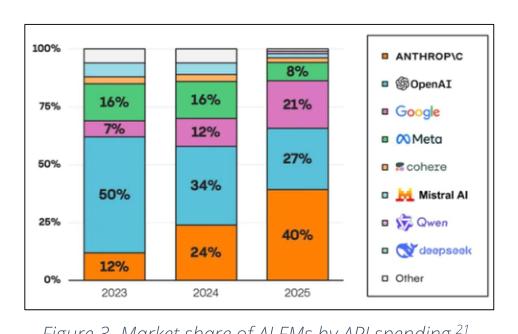
Figure 3. Market share of AI FMs by API spending.21
PDF Page 9
The FM market is concentrated among a few of the largest tech companies in the U.S. According to an analysis of spending on APIs for AI FMs conducted by Menlo Ventures, Anthropic commanded a 40% market share, followed by OpenAI at 27%, Google at 21%, and Meta at 8%.22 This is a significant shift from the end of 2023 when OpenAI represented half of the market, as depicted in Figure 3, a shift that is driven in part by the rise of AI coding agents.23 Civil society experts, academics, government regulators, and even investors have expressed concern about the lack of competition in the FM market. The FM market has a “strong tendency towards market concentration,”24 caused by barriers to market entry due to scarce training data25 and access to specialized chips, as well as economies of scale associated with high fixed costs and low variable costs. Some scholars have argued that the AI FM market has features of a natural monopoly.26 The UK’s Competition and Markets Authority, as well as leading venture capitalists, have echoed these concerns that the FM market may become oligopolistic.27 This market concentration leads to undesirable consequences, such as “extractive prices, quality of service concerns, self-preferencing and other forms of discrimination, as well as harms to downstream innovation, among other concerns.”28 Some experts have dismissed concerns about the impact of concentration on competition and innovation. They argue that the constant threat of a competitor developing a more advanced model will diminish a temporary leader’s ability to exercise market power and squeeze consumers.29 However, instead of promoting
22 Tim Tully et al., supra note 16.
23 Id.
24 Vipra & Korinek, supra note 9 at 2.
25 Pablo Villalobos, Scaling Laws Literature Review, EPOCH AI (Jan. 26, 2023), https://epoch.ai/blog/scalinglaws-literature-review.
26 Tejas N. Narechania, Machine Learning as Natural Monopoly, 107 IOWA L. REV. (2022); Vipra & Korinek, supra note 9; Jon Schmid, Tobias Sytsma & Anton Shenk, Evaluating Natural Monopoly Cnditions in the AI Foundation Model Market, RAND CORP. (Sept. 12, 2024), https://www.rand.org/pubs/research_reports/RRA3415-1.html.
27 AI Foundation Models: Update Paper, COMPETITION AND MKTS. AUTH. (U.K.) (2024), https://assets.publishing.service.gov.uk/media/661941a6c1d297c6ad1dfeed/Update_Paper__1_.pdf; Monopolies vs Oligopolies in AI, A16Z PODCAST 7:00 (Aug. 28, 2024), https://podcasts.apple.com/us/podcast/monopolies-vs-oligopolies-inai/id842818711?i=1000723862797.
28 Tejas N. Narechania & Ganesh Sitaraman, An Antimonopoly Approach to Governing Artificial Intelligence, 43 YALE L. & POL’Y REV. 95, 102 (2024).
29 Monopolies vs Oligopolies in AI, supra note 27.
PDF Page 10
competition, unstable leadership among AI FMs might produce dynamics akin to a “serial monopoly”—a market in which a provider takes a leading position and recognizes monopoly benefits for only a temporary period (say, in the months after the release of a major model). In contrast to an idealized view of creative disruption, a serial monopoly may pose substantial risks for application developers and end-users than ordinary monopolies. In an arena of rapid technological change, small temporal advantages compound rapidly, as first-mover advantages lead to durable market control.30 Moreover, if foundation models were to overtake humans in their ability to improve themselves, it is unclear that the market would retain dynamic leadership or instead revert to sustained monopolization. Thus, even temporary periods of market dominance could be consequential if the underlying FM technology becomes essential. As a result, concentration at the FM level has important downstream consequences throughout the stack. Leading AI researchers view FMs as the “centerpiece of the modern AI ecosystem.”31 They have become a “chokepoint”32 or “gatekeeper”33 for AI application development because developers’ access to FMs can make or break their business. The AI tech stack is increasingly vertically integrated. For example, the three major cloud computing “hyperscalers”—Amazon, Google, and Microsoft—each design chips, offer cloud services, offer FMs, and control key applications where AI is integrated.34 While OpenAI and Anthropic, the leading FM providers, initially positioned themselves as challengers to Big Tech, they depend on Big Tech as suppliers of cloud computing and chips. Moreover, the largest tech companies have taken ownership stakes in these supposedly insurgent FM providers: Microsoft and Nvidia have invested billions in OpenAI; while Amazon, Google, Microsoft, and Nvidia have invested billions in
30 Vipra & Korinek, supra note 9 at 12.
31 Sayash Kapoor et al., On the Societal Impact of Open Foundation Models, 235 in PROCEEDINGS OF THE 41ST INT'L CONFERENCE ON MACH. LEARNING 23082, 1 (2024).
32 Corrigan, supra note 14 at 25.
33 Alexandre de Streel, Gatekeeper Power in the Digital Economy: An Emerging Concept in EU Law, OECD (June 30, 2022), https://one.oecd.org/document/DAF/COMP/WD(2022)57/en/pdf.
34 Asad Ramzanali, How to Regulate the Cloud: A Blueprint to Address the Market Failures and National Security Risks of Cloud Computing, VAND. POL'Y ACCELERATOR 13–17, 58–60 (Sep. 18, 2025), https://cdn.vanderbilt.edu/vu-URL/wp-content/uploads/sites/412/2025/09/18140135/How-to-Regulatethe-Cloud.pdf.
PDF Page 11
Anthropic.35 These interlocking relationships mean that FM providers are entangled in a complex web of simultaneous competitor-supplier- -customer-investor relations with the rest of Silicon Valley. Market Failures Concentration and vertical integration in the FM market facilitate three types of practices that may stifle competition, create conditions for unfair behavior from gatekeepers, reduce innovation, and raise prices:
● Self-Preferencing and Vertical Integration: Companies dominant in one layer of the AI tech stack may use that dominance to preference their own product or disfavor competitors’ products in other parts of the supply chain. For example, hyperscalers offer native cloud-FM integration where they have investments (e.g., Anthropic Claude is natively integrated with AWS and Google Cloud offerings but not Microsoft Azure; OpenAI GPT-5 is natively available only with Azure)36. Today, we see financial arrangements between AI FM providers and third-party AI application developers that create the conditions for self-preferencing. The OpenAI Startup Fund will invest nearly $300 million in AI-powered start-ups,37 and its CEO Sam Altman has invested in hundreds of these companies.38 Investments include companies dependent on OpenAI’s FMs. For example, OpenAI’s Startup Fund invested in Harvey, a legal tech startup that uses OpenAI FMs among others.39 OpenAI now has an incentive to favor Harvey over other legal tech startups—and no current legal barriers to doing so.
35 Partnerships Between Cloud Service Providers and AI Developers, FED. TRADE COMM’N (2025), https://www.ftc.gov/system/files/ftc_gov/pdf/p246201_aipartnerships6breport_redacted_0.pdf; Rafe Rosner-Uddin & George Hammond, Microsoft and Nvidia to Invest up to $15bn in OpenAI Rival Anthropic, FIN. TIMES, (Nov. 18, 2025), https://www.ft.com/content/2f82a42c-7b41-40a4-b549-bce7805166f3.
36 Ramzanali, supra note 34 at 15–16.
37 Marina Temkin, OpenAI’s Startup Empire: The Companies Backed by Its Venture Fund, TECHCRUNCH (Mar. 1, 2025), https://techcrunch.com/2025/03/01/openais-startup-empire-the-companies-backed-by-itsventure-fund/.
38 Berber Jin, Tom Dotan & Keach Hagey, The Opaque Investment Empire Making OpenAI’s Sam Altman Rich, WALL ST. J. (June 3, 2024), https://www.wsj.com/tech/ai/openai-sam-altman-investments-004fc785; Irza Waraich, Sam Altman’s Startup Portfolio: 14 Companies Backed by the OpenAI CEO, OBSERVER (June 25, 2025), https://observer.com/2025/06/sam-altman-startup-investments/.
39 Expanding Harvey’s Model Offerings, HARVEY (May 13, 2025), https://www.harvey.ai/blog/expandingharveys-model-offerings.
PDF Page 12
● Refusal to Deal and Throttling: As gatekeepers, AI FM providers are in a position to restrict access, prioritize supply, or otherwise vary quality of service to customers of their API. There are legitimate reasons to refuse to deal (e.g., denying access to terrorists and criminal groups) or even throttle service quality (e.g., to curb overuse by identified spammers or to prevent a distributed denial of service-like attack), but improper or anticompetitive reasons could emerge when an AI FM provider has financial interest in AI application developers. Here again, we’ve seen examples in the AI market already. An investigation by the Federal Trade Commission (FTC) found that a hyperscaler was deprioritizing a startup’s access to its supply of leading chips to serve a large FM provider with which it had “partnered.”40 In AI, one could imagine model developers throttling or restricting access to start-ups that threaten their core business activities, as we will explore in the next section with the case of Windsurf.
● Bundling, Tying, Exclusive Dealing, and Cross-Market Dominance: Finally, FM providers may use their market power to force customers or users into exclusive usage of their model or require model clients to purchase other products from their parent company in exchange for FM access. Doing so allows a monopoly corporation to extend its monopoly into additional markets, even if it is less efficient in the tied market. Economists have found that tying is particularly pernicious “in industries characterized by substantial innovation where product lifetimes are short.”41 OpenAI and Microsoft’s multi-billion-dollar partnership made Azure the sole cloud computing provider for developing OpenAI's FMs for several years.42 This kind of deal allows the more powerful entity (Microsoft) to extract favorable terms over the then-upstart (OpenAI). Amazon and Google struck similar deals
40 Partnerships Between Cloud Service Providers and AI Developers, supra note 35 at 31.
41 Dennis W. Carlton & Michael Waldman, The Strategic Use of Tying to Preserve and Create Market Power in Evolving Industries, 33 RAND J. ECON. 194, 196 (2002).
42 OpenAI Forms Exclusive Computing Partnership with Microsoft to Build New Azure AI Supercomputing Technologies, MICROSOFT SOURCE (July 22, 2019), https://news.microsoft.com/source/2019/07/22/openaiforms-exclusive-computing-partnership-with-microsoft-to-build-new-azure-ai-supercomputingtechnologies/.
PDF Page 13
with Anthropic.43 The FM providers are no longer smaller upstarts and now exert similar pressures on companies that depend on them. That means that they may be able to squeeze out more innovative competitors at the application layer. With respect to AI applications, Google Search has recently started including “AI Overview” before search results and an “AI Mode” to interact with results, powered by its own Gemini FM. Meta has integrated its AI offering based on its Llama AI FM into WhatsApp, Instagram, and Messenger. Other market failures that could emerge in the AI FM, based on practices observed in adjacent markets, include lock-in and high switching costs, such as through artificial exit fees; using customer data to create copycat products that unfairly compete; and vendor and circular financing that may artificially inflate demand. Additional regulatory structures may be appropriate to address or prevent these and other harms. II. Case Study: Anthropic Cut Access to Windsurf
To understand how FMs might wield anti-competitive power over applications, we examine the case study of the company Windsurf. AI tools that aid software development have emerged as one of the most promising and potentially profitable forms of AI applications. Sometimes dubbed “vibe coding,” these AI coding agents enable non-technical users to generate code and potentially increase productivity for existing software developers.44 AI coding agents are among the most used AI applications and are responsible for some of the most widely felt impacts:45 some evidence suggests they have contributed to reduced employment
43 Press Release, Amazon, Amazon and Anthropic Deepen Strategic Collaboration (Nov. 22, 2024), https://www.aboutamazon.com/news/aws/amazon-invests-additional-4-billion-anthropic-ai.
44 Rhiannon Williams, What Is Vibe Coding, Exactly?, MIT TEC. REV. (Apr. 16, 2025), https://www.technologyreview.com/2025/04/16/1115135/what-is-vibe-coding-exactly/; Benj Edwards, Will the Future of Software Development Run on Vibes?, ARS TECHNICA (Mar. 5, 2025), https://arstechnica.com/ai/2025/03/is-vibe-coding-with-ai-gnarly-or-reckless-maybe-some-of-both/; increased productivity is a contested proposition, see Joel Becker et al., Measuring the Impact of Early2025 AI on Experienced Open-Source Developer Productivity, ARXIV (July 25, 2025), http://arxiv.org/abs/2507.09089.
45 Olivia Moore & Daisy Zhao, The Top 100 Gen AI Consumer Apps (5th Ed.), ANDREESSEN HOROWITZ (Aug. 27, 2025), https://a16z.com/100-gen-ai-apps-5/; Tim Tully et al., supra note 16.
PDF Page 14
prospects for early-career software developers,46 their tools power a significant portion of leading startups,47 and the companies behind the agents are earning hundreds of millions of dollars in revenue.48 But with this increased revenue potential comes new attempts to develop and exert market power. The nascent AI coding product category is already a multi-billion-dollar market49 and exhibiting a “tendency towards market concentration,”50 with 86% of the market claimed by the three largest models alone.51 Users can access vibe coding tools in three primary ways:
● Interacting with a feature embedded in a chatbot owned by an FM company (e.g., ChatGPT will write code for users when prompted to do so). ● Using an AI coding agent product owned by a major FM provider (Claude Code, ChatGPT Codex, Gemini Code Assist). ● Using a third-party AI coding agent independent of major AI FM providers (e.g., Windsurf,52 Lovable, Bolt, Replit); in which a major AI FM provider invests (Cursor53); or owned by a company that invests in a major AI FM provider (Microsoft GitHub Copilot).
46 Anthropic Economic Index: AI’s Impact on Software Development, ANTHROPIC (Apr. 28, 2025), https://www.anthropic.com/research/impact-software-development; Erik Brynjolfsson, Bharat Chandar & Ruyu Chen, Canaries in the Coal Mine? Six Facts about the Recent Employment Effects of Artificial Intelligence, STAN. DIG. ECON. LAB & STAN. INST. FOR HUMAN-CENTERED AI (Aug. 26, 2025), https://digitaleconomy.stanford.edu/wpcontent/uploads/2025/08/Canaries_BrynjolfssonChandarChen.pdf.
47 Ivan Mehta, A Quarter of Startups in YC’s Current Cohort Have Codebases That Are Almost Entirely AIGenerated, TECHCRUNCH (Mar. 6, 2025), https://techcrunch.com/2025/03/06/a-quarter-of-startups-in-ycscurrent-cohort-have-codebases-that-are-almost-entirely-ai-generated/.
48 Chloe Aiello, Vibe Coding Just Minted Another $100 Million-Revenue Company in Record Time, INC (July 28, 2025), https://www.inc.com/chloe-aiello/vibe-coding-just-minted-another-100-million-revenue-companyin-record-time/91219434; Coding AI Agents Are Taking off — Here Are the Companies Gaining Market Share, CB INSIGHTS (Sept. 2, 2025), https://www.cbinsights.com/research/report/coding-ai-market-share-2025/.
49 Stephanie Palazzolo, Revenue From AI Coding Tools Surpasses $3.1 Billion, THE INFORMATION (Nov. 25, 2025), https://www.theinformation.com/articles/revenue-ai-coding-tools-surpasses-3-1-billion.
50 Vipra & Korinek, supra note 9 at 2.
51 Tim Tully et al., supra note 16.
52 Windsurf was acquired by Cognition AI though its CEO had been hired by Google in what’s increasingly recognized as a “reverse acquihire,” a hiring designed to evade regulatory scrutiny of acquisitions. Maxwell Zeff, Cognition, Maker of the AI Coding Agent Devin, Acquires Windsurf, TECHCRUNCH (July 14, 2025), https://techcrunch.com/2025/07/14/cognition-maker-of-the-ai-coding-agent-devin-acquires-windsurf/.
53 Temkin, supra note 37 (“In October 2023, OpenAI’s fund led the $8 million seed round into Anysphere, the maker of AI-powered coding assistant Cursor. OpenAI hasn’t been named as an investor in the company’s subsequent rounds.”).
PDF Page 15
Like many AI applications, independent AI coding agents are often “wrappers” around AI FMs where developers build narrower technologies and interfaces that let users access the FM for specific workflows or use cases. The coding agents’ business, then, is entirely dependent on FM developers. Indeed, the term wrapper itself betrays coding agents’ reliance on FMs: without them, they are hollow. Take Windsurf, for example, a popular coding agent that received media attention for disputes with model providers. Today, the product allows users to choose from over 20 FMs, including ones released by OpenAI, Anthropic, Google, xAI, DeepSeek, and Alibaba,54 with its default model based on Claude. Launched in 2021 as a tool to optimize semiconductor workloads, the company pivoted to build an AI-powered coding application called Codeium in 2022.55 By November 2024, the company had created what they consider the “first agentic” integrated development environment (IDE) for software development.56 By April 2025, Windsurf boasted annualized recurring revenue (ARR) of $100 million and among the highest customer retention rates in the industry. OpenAI began talks to acquire Windsurf for $3 billion.57 On May 5, 2025, press reports indicated the parties had reached a deal.58 But less than one month later, before any official announcement of Windsurf’s acquisition by OpenAI, Anthropic notified Windsurf that it would discontinue the coding agent’s access to APIs for Claude 3 Sonnet LLMs within five days. Media reports documented “frustrated” Windsurf users, some of whom left the application for one of its
54 Models, WINDSURF, https://docs.windsurf.com/windsurf/models (last visited Nov. 1, 2025).
55 Press Release, Windsurf, The Next Chapter: Renaming to Windsurf (Apr. 4, 2025), https://windsurf.com/blog/windsurf-rebrand-announcement.
56 Id.
57 Rachel Metz, Kate Clark & Shirin Ghaffary, OpenAI In Talks to Buy Windsurf for About $3 Billion, BLOOMBERG (Apr. 16, 2025), https://www.bloomberg.com/news/articles/2025-04-16/openai-said-to-be-intalks-to-buy-windsurf-for-about-3-billion; Marina Temkin & Maxwell Zeff, Why OpenAI Wanted to Buy Cursor but Opted for the Fast-Growing Windsurf, TECHCRUNCH (Apr. 22, 2025), https://techcrunch.com/2025/04/22/why-openai-wanted-to-buy-cursor-but-opted-for-the-fast-growingwindsurf/; Stephanie Palazzolo & Shane Burke, Which Coding Assistants Retain Their Customers and Which Ones Don’t, THE INFORMATION (June 25, 2025), https://www.theinformation.com/articles/coding-assistantsretain-customers-ones.
58 Katie Roof & Rachel Metz, OpenAI Reaches Agreement to Buy Startup Windsurf for $3 Billion, BLOOMBERG (May 6, 2025), https://www.bloomberg.com/news/articles/2025-05-06/openai-reaches-agreement-tobuy-startup-windsurf-for-3-billion.
PDF Page 16
competitors.59 An Anthropic spokesperson suggested that the rationale for the action was based on “…prioritizing capacity for sustainable partnerships…”60 Two days after that notification, Anthropic co-founder and Chief Science Officer Jared Kaplan was asked by reporter Maxwell Zeff about the decision at a conference hosted by technology news outlet TechCrunch. Kaplan responded that Anthropic was “just trying to enable our customers who are going to sustainably be working with us in the future…I think it would be odd for us to be selling Claude to OpenAI.”61 In essence, because Windsurf was reportedly getting closer to OpenAI’s orbit, Anthropic didn’t see the customer as one worth serving. Zeff then put the situation in the context of how end users and many in Silicon Valley might see Anthropic’s actions: “What a lot of startups and developers saw was that Anthropic can just cut off access… Maybe your startup isn’t competing with Anthropic today, but maybe in the future you will.”62 “Ultimately, this week served as a wake-up call for the many startups building businesses on the backs of AI models,” another columnist observed, “if you are successful enough, you run the risk of being copied by your model provider.”63 By October, media reports suggested that Anthropic’s own coding agents had become a key part of the company’s business success, especially as it competes with OpenAI for corporate clients,64 and Windsurf had been acquired by a different company.65 In January 2026, press reports suggested that Anthropic had
59 Maxwell Zeff, Windsurf Says Anthropic Is Limiting Its Direct Access to Claude AI Models, TECHCRUNCH (June 3, 2025), https://techcrunch.com/2025/06/03/windsurf-says-anthropic-is-limiting-its-direct-access-toclaude-ai-models/; Press Release, Windsurf, Statement on Anthropic Model Availability(June 3, 2025), https://windsurf.com/blog/anthropic-models.
60 Zeff, supra note 59.
61 Maxwell Zeff, Anthropic Co-Founder on Cutting Access to Windsurf: “It Would Be Odd for Us to Sell Claude to OpenAI,” TECHCRUNCH (June 5, 2025), https://techcrunch.com/2025/06/05/anthropic-co-founder-oncutting-access-to-windsurf-it-would-be-odd-for-us-to-sell-claude-to-openai/.
62 Anthropic’s Jared Kaplan on the Future of AI Agents l TechCrunch Sessions: AI, 6:45 (2025), https://www.youtube.com/watch?v=Ly8uHk4S70M. Another reporter previously asked Anthropic’s chief product officer, Mike Krieger, how the company thinks about competing with its API customers. Krieger responded that was a “delicate question for all of the labs.” Alex Heath, Anthropic and OpenAI Make Moves against Popular AI Apps, THE VERGE (June 7, 2025), https://www.theverge.com/command-linenewsletter/682102/popular-ai-apps-crosshairs-anthropic-openai.
63 Heath, supra note 62.
64 Asa Fitch, OpenAI’s Less-Flashy Rival Might Have a Better Business Model, WALL ST. J. (Oct. 26, 2025), https://www.wsj.com/tech/ai/anthropic-business-model-ai-9e26b4ef.
65 OpenAI’s acquisition of Windsurf never closed, due in part to Windsurf’s concern of how OpenAI’s agreement with Microsoft would affect the product. Google completed what’s increasingly being called a “reverse acqui-hire” of key Windsurf leaders, including its CEO, for $2.4 billion. Cognition, maker of a
PDF Page 17
taken actions to curtail xAI’s use of Cursor, the largest independent AI coding agent. Instead of curtailing access to an Anthropic customer, the company blocked its customer’s customer, abusing its role as a gatekeeper.66 As FM providers start to compete with their customers, concerns will continue to rise about potential conflicts of interest and abuses of power. III. Neutrality Can Support Innovation Anthropic’s termination of Windsurf’s API access is an early example of discrimination between AI models and AI applications. However, this kind of behavior is common among other tech platforms. Self-preferencing has been documented, for example, on Amazon’s retail platform, Google Search, Apple’s App Store, and Meta’s social graph APIs.67 At their core, neutrality requirements, sometimes called nondiscrimination rules, require that an essential business treat similarly situated customers the same. Policymakers have applied these kinds of requirements in telecommunications, both as net neutrality regulations applied to broadband providers in recent years68 and half a century earlier for the traditional telephone network69 in a regime Tim Wu himself has
competing AI coding agent, acquired the rest of Windsurf for an undisclosed amount. Miles Kruppa, Natasha Mascarenhas, & Erin Woo, Google to Pay $2.4 Billion for Windsurf Staff, IP After Startup Ends OpenAI Talks, THE INFORMATION (July 11, 2025), https://www.theinformation.com/articles/openai-windsurfbreak-acquisition-talks-microsoft-ip-concerns; Zeff, supra note 52; Ashley Capoot, Cognition to Buy AI Startup Windsurf Days after Google Poached CEO in $2.4 Billion Licensing Deal, CNBC (July 14, 2025), https://www.cnbc.com/2025/07/14/cognition-to-buy-ai-startup-windsurf-days-after-google-poachedceo.html.
66 Franzen, supra note 3.
67 Mikaela Pyatt, Rulemaking to Bar Self-Preferencing by Technology Platforms, 26 STAN. TECH. L. REV. 143 (2023). 68 Safeguarding and Securing the Open Internet, Declaratory Ruling, Order, Report and Order, and Order on Reconsideration, 39 FCC Rcd 4975 (2024).
69 Regulatory and Policy Problems Presented by the Interdependence of Computer and Communication Services and Facilities, Final Decision and Order (commonly, Computer I), 28 FCC Rcd 267 (1971).
PDF Page 18
called the “first net neutrality rules;”70 transportation;71 and banking.72 English courts have applied a similar duty on inns since at least the fourteenth century.73 More recently, lawmakers have proposed the American Innovation and Choice Online Act (AICOA) that would ban self-preferencing by large tech platform operators in digital markets,74 likely including AI models. However, while AICOA impacts a broader swath of digital industries, it would require the FTC and Department of Justice (DOJ) to jointly designate a company’s service as a covered platform based on certain criteria.75 Instead, the approach recommended in this paper is a sectoral regulatory approach applying broadly to AI FM providers.76 In this context, a simple neutrality rule would prohibit AI FM providers that make available an API for external parties to treat calls from unjust or unreasonably discrimination among similarly situated users in terms of access, latency, cost, and quality of service. The requirement should clarify exceptions for dealing with, for example, unlawful activity, AI efforts of adversarial nations, and misuses of FMs that can create fraud or security risks. Importantly, the rule would allow FM providers to offer differentiated tiers of service at different prices on the open market—as long as those tiers do not create unreasonable or unjust discrimination. The rule should also prevent potential methods of circumventing regulations against unfair customer practices (e.g., charging for switching costs or multi-FM operations). So, Anthropic would not have been able to curtail Windsurf’s access to Claude (or charge more, limit API calls, or otherwise degrade the offering).
70 TIM WU, THE AGE OF EXTRACTION: HOW TECH PLATFORMS CONQUERED THE ECONOMY AND THREATEN OUR FUTURE PROSPERITY 36-40 (2025). 71 See, e.g., Interstate Commerce Act, Pub. L. No. 49-104, 24 Stat. 379, § 4 (1887). 72 Bank Holding Company Act Amendments of 1970 § 106(b)(1), 12 U.S.C. 1972(1); Investment Advisers Act of 1940 § 206, 15 U.S.C. § 80b-6.
73 Wu, supra note 70 at 162-164. 74 American Innovation and Choice Online Act, S. 2992, 117th Cong., §3(a) (2022); other stakeholders have proposed applying net neutrality-like rules to other digital gatekeepers, see, Joel Thayer, Stack Neutrality: The Holistic Approach to Net Neutrality, WASHINGTON EXAMINER (Mar. 11, 2021), https://www.washingtonexaminer.com/opinion/2600527/stack-neutrality-the-holistic-approach-to-netneutrality/. 75 American Innovation and Choice Online Act, S. 2992, 117th Cong., §3(d) (2022). 76 Other sector regulatory approaches for digital markets include, e.g., Open App Markets Act, S. 2153, 119th Cong. (2025); Advertising Middlemen Endangering Rigorous Internet Competition Accountability (AMERICA) Act, S. 1073, 118th Cong. (2023).
PDF Page 19
Various experts and organizations have discussed or called for neutrality requirements, nondiscrimination rules, open access provisions, or related precompetition policies for AI FMs: Narechania and Sitaraman (VPA);77 Corrigan (Center for Security and Emerging Technology);78 Huber and Buck;79 Moure, O'Reilly, and Strauss (AI Disclosures Project);80 Vipra (AI Now) and Korinek (Brookings);81 Li (Stanford HAI);82 and Wheeler (Brookings).83 The key benefit of a neutrality requirement is to enable innovation at the AI application layer. Today, the financial interests of AI FM providers (e.g., investments in third-party AI applications or the development of their own applications) present an inherent conflict of interest when serving customers with access to an API. If and when AI FMs discriminate among similarly situated customers to preference applications they own, in which they have an investment or other financial interest, or which may create competitive disadvantages for the company in other markets, they skew the market and hinder competition among nascent AI applications. Neutrality in the FM market could be pursued in four separate ways. First, Congress could pass a law that requires FM providers to retain neutrality in responding to API calls. Second, the FTC could use its existing authorities over unfair methods of competition to promulgate regulation prohibiting the practice. Third, harmed parties, state attorneys general, or federal antitrust regulators could seek neutrality as a remedy in lawsuits related to violations of antitrust laws. Fourth, AI model companies or an association of such companies could voluntarily agree to neutrality principles.
77 Narechania & Sitaraman, supra note 28 at 162.
78 Corrigan, supra note 14 at 32.
79 Matt Huber & Holly Buck, Treat AI Like a Public Utility, JACOBIN (July 17, 2025), https://jacobin.com/2025/07/artificial-intelligence-regulation-public-utility (“At a certain scale, large AI systems could be regulated like utilities: forced to provide reasonable rates and access…”).
80 Isobel Moure, Tim O’Reilly, & Ilan Strauss, Open Protocols Can Prevent AI Monopolies, AI FRONTIERS (July 30, 2025), https://ai-frontiers.org/articles/open-protocols-prevent-ai-monopolies.
81 Vipra & Korinek, supra note 9 at 3.
82 Fei-Fei Li, Now More than Ever, AI Needs a Governance Framework, FIN. TIMES (Feb. 8, 2025), https://www.ft.com/content/3861a30a-50fc-41c9-9780-b16626a0d2e8.
83 Tom Wheeler, OpenAI Floats Federal Support for AI Infrastructure—What Should the Public Expect?, BROOKINGS INST. (Nov. 18, 2025), https://www.brookings.edu/articles/openai-floats-federal-support-for-aiinfrastructure-what-should-the-public-expect/.
PDF Page 20
Congressional action is the most direct path for a sector-wide solution.84 FTC rulemaking would be the first of its kind in the modern era and surely lead to litigation. Statutory text defining API call discrimination as “unfair competition” would eliminate legal uncertainty as to the FTC’s ability to promulgate these regulations. Moreover, antitrust litigation is time- and resource-consuming, and would require a “whack-amole” style of remedies for each individual AI model developer. Finally, companies lack incentives to pursue voluntary limits without policy pressures, and resulting selfregulatory regimes are often ineffective at uncovering violations. For these reasons, we include a sample statutory proposal for AI model neutrality that has three parts: (1) a general conduct rule; (2) prohibitions on specific practices; and (3) transparency requirements. Conclusion
The AI market is driving substantial growth in the American economy, a time when many industries are experiencing stagnation. Technological leadership is also central to American geopolitics. However, all of this investment in infrastructure will only yield dividends if AI applications enhance productivity, discovery and innovation, and national security. As thousands of startups aim to build AI applications, AI FM providers should not be able to pick winners and losers based on their own narrow financial interests. That is unfair to other competitors, and it hinders innovation. As we propose, a neutrality rule is a proven way to limit the powers of a gatekeeper that may have incentives to engage in anti-competitive behavior.
84 While this proposal focuses on federal legislative actions, state policymakers may be able to enact similar ideas within their borders, as has happened in other nondiscrimination contexts. See, e.g., California Internet Consumer Protection and Net Neutrality Act of 2018, Cal. Stats. 2018, ch. 976 (SB 822) (codified at Cal. Civ. Code §§ 3100 et seq.); ACA Connects v. Bonta, No. 21-15430, 24 F.4th 1233 (9th Cir. 2022).
PDF Page 21
Appendix: Sample Legislative Language
This appendix depicts sample legislative text that reflects the substance of the recommendation in this paper. The goal of this appendix is to give interested legislative drafters a blueprint for how the recommendations of this paper might be enacted. A full legislative proposal would need to consider implementation and enforcement. Congress could assign enforcement to the FTC,85 Federal Communications Commission,86 or another agency (e.g., future digital regulator87), and the statute could allow for enforcement by state attorneys general and private parties. A full legislative proposal could also include other clauses, such as rules of construction, savings clauses, severability provisions, and effective date. Sec. __. Foundation Model Neutrality.
(a) Neutrality.—
(1) In general.—It shall be unlawful for a foundation model provider to make any unjust or unreasonable discrimination in charges (including prices, rates, fees, discounts, trials, or any other practice substantially impacting charges paid by a customer), practices (including access, speed, latency, rate limits, reliability, uptime, and version availability of models or application programming interfaces), classifications, regulations, facilities, or services for or in connection with similarly situated customers of foundation models, directly or indirectly, or to make or give any undue or unreasonable preference or advantage to any particular person or class of persons.88
(2) Covered affiliations.—The prohibition in paragraph (1) applies to all customers including those—
85 For sample enforcement provisions in proposed legislation, see, Platform Competition and Opportunity Act, H.R. 3826, 117th Cong. §§ 4-8 (2021); American Innovation and Choice Online Act, S. 2992, 117th Cong. §§ 3-4 (2021); Open App Markets Act, S. 2710, 117th Cong. §5.
86 Given its history implementing the Safeguarding and Securing the Open Internet and similar rules.
87 See, e.g., Digital Platform Commission Act, S. 4201, 117th Cong. (2022); Digital Consumer Protection Commission Act, S. 2597, 118th Cong. (2022); MARK MACCARTHY, REGULATING DIGITAL INDUSTRIES: HOW PUBLIC OVERSIGHT CAN ENCOURAGE COMPETITION, PROTECT PRIVACY, AND ENSURE FREE SPEECH (2023).
88 Modeled on Communications Act of 1934 § 202 (codified at 47 U.S.C. § 202).
PDF Page 22
(A) that are owned or operated by the covered foundation model provider;
(B) that have a beneficial interest or an investment in the covered foundation model provider;
(C) in which the covered foundation model provider has a beneficial interest or an investment; or
(D) with which the covered foundation model provider has a partnership or other affiliation.
(b) Specific practices prohibited.—A covered foundation model provider may not—
(1) offer a bundle that includes access to a foundation model with a product not required for the provision of such foundation model;
(2) prioritize limited supply of computing or other resources used to make available a foundation model (or any feature or component thereof) in a manner that favors any person with a covered affiliation described in subsection (a)(2);
(3) charge fees or other charges associated with a customer switching to another foundation model or using multiple models simultaneously;
(4) A covered company shall not use nonpublic business information derived from a third-party app for the purpose of competing with that app; and
(5) condition access to the products or services of the covered foundation model provider based on a practice otherwise prohibited in this subsection.
(c) Transparency.—A covered foundation model provider must post in an easily accessible and public location on its website—
(1) policies related to denial of service;
(2) all prices, including charges, rates, fees, discounts, trials, or other practices substantially impacting charges paid by a customer; and
(3) all policies related to quality of service, including prioritization of access to a foundation model or interfaces required to access the foundation model, including an application programming interface.
PDF Page 23
(d) Rule of construction.—Nothing in this section shall be construed to require a covered entity to—
(1) provide access to an entity—
(A) controlled by a foreign adversary, as such term is defined in section 2(g) of the Protecting Americans from Foreign Adversary Controlled Applications Act (15 U.S.C. 9901 note.); or
(B) included in any determination or list—
(i) described in section 2(c) of the Secure and Trusted Communications Networks Act of 2019 (47 U.S.C. 1601(c)); or
(ii) maintained by the Federal Government by which entities—
(I) are identified as limited or prohibited from engaging in economic transactions as part of United States sanctions or export-control regimes; or
(II) have been identified as national security, intelligence, or law enforcement risks;
(2) obstruct good faith compliance with a law, regulation, valid subpoena, court order, or warrant, or otherwise required by law; or
(3) protect against malicious, deceptive, fraudulent, or illegal activity or to prevent or respond to security incidents.
(e) Definitions.—In this section:
(1) Artificial intelligence.—The term “artificial intelligence” has the meaning given the term in section 5002 of the National Artificial Intelligence Initiative Act of 2020 (15 U.S.C. 9401).
(2) Artificial intelligence application.—The term “artificial intelligence application” means any software application or system or hardware application or device that operates in whole or in part by utilizing a foundation AI model or the outputs of a foundation AI model.
(3) Covered foundation model provider.—The term “covered foundation model provider” means—
PDF Page 24
(A) a person using interstate or foreign communications to offer a foundation model; or
(B) a person that owns or controls (as such term is defined in section 800.208 of title 31, Code of Federal Regulations, or successor regulation) a person described in subparagraph (A).
(4) Foundation model.—The term “foundation model” means a component of an information system offered that implements artificial intelligence technology and uses computational, statistical, or machine-learning techniques to produce outputs from a given set of inputs.
(5) Person.—The term “person” has the meaning given the term in subsection (a) of section (1) of the Clayton Act (15 U.S.C. 12).